
   INTRODUCTION

      Kenneth Rosen
         FORGING REALITY, THE POETRY OF OSWALD LE WINTER

      Karl Krolow
         EXCERPT FROM THE JUDGE'S STATEMENT ON AWARDING
         THE INTERNATIONAL RILKE PRIZE TO OSWALD LE WINTER

   CONTENTS

      THE POETRY OF OSWALD LE WINTER

         A MAGNASCO SEA
         TRIBAL WARS
         LEDA
         WHAT OF THE QUARRY?
         MRS. TAYLOR'S LIFE
         THE DANCER AT VERSAILLES II
         HISTORY
         AN AMERICAN REQUIEM
         A TINY MIRACLE
         TRUE SCALE
         EQUINE LOVE
         ADAM ANSWERS EVE
         ADRIFT ON THE ICEBERG OF TIME
         SOLDIER’S FAREWELL
         THE STORM BEFORE THE CALM
         IN TENEBRIS
         BENNINGTON, JULY 1955
         ENTOMBED NIGHT
         DEATH OF A BULL RHINO
         HOELDERLIN AT HEIDELBERG
         BLACK SUN
         BOATING A SHARK
         JOSEPH CONRAD BEFORE THE NELSON MONUMENT
         FATIMA
         COSTA DA CAPARICA
         PORTUGUESE FLIES
         LIKE A RIDDLE-POTENT KNOT
         COSSACKS
         BEACHSIDE CEMETERY
         IN THE HOSPITAL BEHIND THE FRONT
         BREAKFAST IN HELL
         NOCTES IRAE
         BORDER TRADE
         YOU CAN'T MAKE POETRY FROM A FART
                                                                                                           Translated by Mirja Kraemer

   POST SCRIPTUM

      Oswald Le Winter

         Credits

   Kenneth Rosen


   FORGING REALITY, THE POETRY OF OSWALD LE WINTER


      Oswald LeWinter is an American poet living in Portugal. He was born in
   Vienna, Austria, separated from his family and shipped by boat to America
   to escape the holocaust of the Third Reich. In the United States he lived
   in a Philadelphia orphanage for Jewish refugees and did not see his parents
   again until he was ten and they had immigrated. He was educated at U. Cal.,
   Berkeley, where he lettered in track and was an all-star football player,
   declining an opportunity to try-out with the San Francisco  professional
   football team in order to become a U.S. Ranger and serve in Korea. Eventually
   LeWinter completed his advanced degrees at Columbia University, and acquired
   a doctorate in psychology in Germany. LeWinter worked on many continents
   for many years, primarily in disinformation and disruption, for American
   Central Intelligence. Most recently he was for three years in Vienna,
   place of his birth, as an involuntary guest of the Austrian government,
   for seeking to provide the aggrieved Egyptian billionaire Mohamed El Fayed
   with documents illustrating Buckingham Palace and British intelligence
   services' involvement with the death of his son Dodi El Fayed and Dodi's
   fiancee Princess Diana, in return for money. Mohamed El Fayed subsequently
   and unsuccessfully sued the American government under the Freedom of
   Information Act for the same papers he declined to purchase from retired
   General LeWinter, explaining in court that LeWinter's papers were forgeries
   of genuine documents.

   Thus besides intimate acquaintance with America's principal poets and
   critics of the last fifty years, which LeWinter accomplished by energy,
   acumen, and poetic versatility, literary lights whose reputations have
   fluctuated like American allegiances in the Middle East, American loyalty
   to hard-pressed or compromised intelligence operatives, or the American
   stock market, LeWinter's stream of surprise and disillusioned realpolitik
   is informed by his extraordinary involvement in the international intrigues
   of the same period. Like his life, LeWinter's poetry dramatizes the
   "American" centuries' violent inversion of vivid realities: physicians
   attempt to make human limbs from mud, blood-puddles and bone crumbs "In
   the Hospital Behind the Front"; a dog is lovingly appreciated for its
   misconception of itself as a snapping crocodile in "Portuguese Flies"; and
   in "Tribal Wars," the ‘mambas' of intra-familial antipathy between cousins,
   in both his father's generation and his own, are deadlier than the bullets
   of Nigerian inter-tribal hostilities, where the poet had been sent to
   assess contending factions for their prospective contribution to American
   regional interests, presumably oil. Morever, the cousin Joe with whom the
   poet has no hope of rapproachment, once sealed their mutual love "in
   childhood when each pressed/His nicked wrist against the other's as a bond."
   Rage at the confusion over what is essentially human that has infested our
   civilization, and the inevitable betrayal of essential humanity our
   arrogant hysteria entails, is expressed by the force with which LeWinter
   forges a lyric utterance from an immense historical and literary erudition,
   and from an equally immense stylistic range. Oswald LeWinter's poetry is
   the bad news that comes closer to the truth than most of the poetry
   currently read and written, and his vision and authority were earned the
   hard way.


   Kenneth Rosen is author of the recently published collection of poems, THE
   ORIGINS OF TRAGEDY, CavanKerry Press, Fort Lee, NJ.
   Portland, Maine
   April 6, 2003


   EXCERPT FROM THE JUDGE'S STATEMENT ON AWARDING
   THE INTERNATIONAL RILKE PRIZE TO OSWALD LE WINTER

   January 1997

   Oswald LeWinter is one of a kind in contemporary American poetry. He may,
   in fact, be unique in the annals of modern poetry in any country. His life
   sounds like a tale composed by Baron Munchhausen and edited by John Le
   Carre. Born in Vienna in 1931, he escaped the Holocaust by being chosen as
   one of only 1,000 Jewish children from all of Europe, tested for their
   intelligence quotients and permitted to enter the United States in 1939.
   After two years in an Orphanage, he was united with his parents. He grew
   up as a street child, since both parents had to work, in one of the poorest
   sections of New York. He graduated from High School at 16 and from a major
   university at 19. He has confirmed that he entered the Army in 1950, in
   time to take an active part in the Korean conflict, more out of gratitude
   to the country that had adopted him than out of patriotism. He became a
   highly decorated war hero and prisoner of war and came home in 1953. He
   fulfilled his service obligations until 1959 rising to the rank of Major,
   when he transferred to the reserves and returned to the university to
   obtain his doctorate and to teach. He had begun to write poetry in his
   thirteenth year and saw his first poems published in 1948, and collected
   in two books that friends had paid for, in 1959 (To Encircle the Center)
   and 1962 ( A Horse of Air). Although both editions were severely limited
   in number, his work was noticed and he began to receive the acclaim and
   the friendship of a number of older poets and some of his own generation.
   William Carlos Williams praised him in a letter (published in his Selected
   Letters), Thomas Mann and Herman Hesse corresponded with him, and his
   friend and near contemporary, Robert Lowell said of his poetry that it
   "brings together the richness of European philosophical poetry.with the
   muscularity of the American idion more successfully than any poet of his
   generation." He began to receive prizes and his work attracted translators
   such as Juan Liscano in Venezuela, and major poets in France and Germany.
   He enjoyed the friendship of the finest poets of his time, men like James
   Dickey, Karl Shapiro, De Witt Snodgrass, Louis Simpson and Thomas Merton.
   His poems were anthologized (Best poems of 1962) and he was invited to
   give readings in many universities. In 1963, he published a scholarly work,
   (Shakespeare in Europe) which established his reputation as a serious
   Shakespeare scholar. A devoted admirer of the life and work of the
   soldier-poet, Sir Philip Sidney, he left the academic world in 1965
   desiring to be an actor in the history of his time rather than a spectator.
   He entered one of the intelligence services of his country, was activated
   by the Army and served 20 years with both, rising to a high rank, and
   playing a major role in some of the most dramatic events of the second
   half of this century. In 1985, he was forced to resign from both for
   having been part of Iran-Contra and was jailed for two years. He had
   stopped publishing in 1965. His last poem had appeared in the American
   quarterly, The Sewanee Review and had earned him a letter of praise from
   T.S. Eliot together with an invitation to submit a book manuscript to
   Faber and Faber. Le Winter never responded to this invitation. His
   silence deepened, felt himself deeply wronged by the country he had
   served with such dedication and which had criminalized him and he
   slowly became a forgotten man and one despised by former friends who
   took his acceptance of a position with an intelligence agency as a sign
   that he had developed what one of them wrote in a letter "faschistoid"
   tendencies. His silence continued but he never stopped writing. He began
   to write poems in his mother tongue as well as in English in 1988. In 1994
   he published a book of poems in German (Qualverwandtschaften, 'Tormenting
   Relations"), stunning, awesome in its breadth and power dealing chiefly
   with the unique relationship between Germans and German Jews. These poems
   are not accusatory. They are subtly filled with  the problems in that
   relationship, latent envy, suppressed mutual admiration and its tragic
   results in the Nazi era. They are wise poems, courageous poems and poems
   full of powerful metaphors and a directness which privileges le mot juste,
   the precise word to convey compactly and fluidly a multitude of levels
   that is the reality of the poet's life. Oswald LeWinter most assuredly
   deserves the prize with which we honor him today. He follows Yvan Goll,
   Giuseppe Ungaretti and the first recipient, Fernando Pessoa. He adds his
   own distinction to their august company.

   Karl Krolow
   Translated by Heidrun Boeker


   THE POETRY OF OSWALD LE WINTER


   A MAGNASCO SEA
   ~~~~~~~~~~~~~~

                    For Yael

   White caps mime a school of dolphins
   arching through swift water; a Magnasco sea.
   In memory's Cyclops eye, I see my daughter
   astride the spume. Her glazed eyes turn to me.

   Then, swift as western light, she vanishes
   beneath the ocean’s skin and I am left behind
   with a soul, robbed of joys, now full of night,
   aged, steadied by a cane: My future blind.

   Her fingers raced across the ivory keys
   chasing arpeggios with girlish glee. She lay
   beside the pool, a Nereid, sunning,
   or wound daisies in her hair on a rainy day.

   She was the sum of love the first moment
   she appeared, smeared with blood.  I stood
   and watched her curled in fetal sleep,
   before the antiseptic glass as often as I could.

   These days I walk beside the ocean, slow,
   laced with pain. Can I accept the mystery
   of the sea, that I won't see or listen to her again,
   and learn that loss remains loss, finally?


   TRIBAL WARS
   ~~~~~~~~~~~

   My father and his Mandel cousin
   Fired epithets at each other
   For two decades. Deadlier
   Than mortars or mere bullets,
   The verbal mambas killed
   The spirit, and left the body
   A husk of crushed memories.

   They had been born hours apart
   And slept in the same bed
   Before steerage took Max to America
   While father, glued to Vienna,
   Needed the threat of extinction
   To move his ass, and my mother,
   To the new world's ghetto.

   Cousin Max, moneyed from bread
   He baked each morning at four,
   Took me to the shelter for refugees
   Where he told my father to expect
   Nothing from him except old coats.
   "In America," he said with his Yankee-
   Yiddish, "a real man finds his own way."

   2.

   In 1967, Thirty-six years old, I was
   Ordered to Nigeria where the mambas
   Had become bullets. A tribal war,
   Between secessionist Biafra
   And the legal dictator was piling
   Corpses up and down the roads.
   The savannahs had turned red and wet.

   Taxiing the 25 kilometers into Lagos
   From the sandbagged airport,
   I dissected my assignment: To discern
   The side America should embrace.
   Who held the kings and aces that would
   End in the annihilation of opponents?
   Who was ready to embrace America?

   The hotel was worse than substandard
   And the mosquitoes hummed louder
   Than the yawing fans in my room.
   Moving between the combatants
   Without making my shaved white face
   A target was an exercise in craftiness
   I perfected with the sweating speed of fear.

   Ojukwu and Gowon, the two opposing
   Generals, glowered at me from walls
   Scarred by bullets in Kano and in Lagos.
   I was to recommend which of them
   Should die, an accident of assassination.
   Induced suicide was an alternative.
   I had been schooled in how Lumumba died.

   I was reprieved when events overtook
   My waffling and the shooting stopped.
   History forced the two Generals to accept
   Its own preconceived design. The war came
   And the war went. The tribes lost no love
   For each other after mortar shells
   And bullets stopped parceling out the air.

   3.

   Max and my father both died
   Without having taken one another's hand
   Or traded one forgiving word.
   Their tribal war created its own history
   That found heirs in my cousin Joe and me.
   We never even speak to one another.
   Ours is no war of attrition, only a dumb conflict
   Disguised by strict silence and the pretense
   That neither of us, the two survivors,
   Cares that we continue to betray
   The common childhood when each pressed
   His bloody wrist against the other's as a bond.


   LEDA
   ~~~~

                    For Jill Johnston

   Of such a madder music he was made,
   That swan, Leda gasped beneath the billowing
   Of his uncommon wing. Silent, resigned

   To glories which she knew no more of yet
   Than instinct's random summoning, she seized
   The trumpeting breast and cowered under

   Arrogance until, transported to a calm
   Beyond fear, she succumbed and sank to rest
   Beside what seemed once more merely fowl.


   WHAT OF THE QUARRY?
   ~~~~~~~~~~~~~~~~~

   What of the quarry
   The hunters abandon?
   What shall be done
   With the furtive doe?

   When shout and shot
   No longer resound,
   When flagging leaves
   Fall free of their boughs,

   How shall the hunted live,
   Freed from the chase
   That circled their hours
   And muscled their feet,

   That taught them the lore
   Of shadow and woods
   And widened their world
   With staggering paths?


   MRS. TAYLOR'S LIFE
   ~~~~~~~~~~~~~~~~~~

   She lives in a porcelain ghetto,
   Among Wedgwood, Sevres, Meissen,
   Noritake and Limoges; her skin
   With its fine lines, needle-thin fingers
   And feet, pale as the dancer's that adorns
   The mantel above the still virgin fireplace,
   From the hand of some master artisan.

   Looking at her one might suppose
   We treasure most what is nearest
   Our own image in the soul: Or
   That what's beyond nature finds us
   Mysteriously and joins with us in a new skin
   To perfect all that the impure world
   Perceives as wrought perfection.

   For us, nature and art are split like a tree
   Through which lightning raced leaving a veneer
   Of carbon on its path. Art imitates art, and only art.
   The Chelsea dancer is eternal. Even if she broke
   In a thousand shards, a life like mine or Mrs. Taylor's
   While achieving at the final breath a wholeness,
   Passes like storms, but not like inspiration.


   THE DANCER AT VERSAILLES II
   ~~~~~~~~~~~~~~~~~~~~~~~~~~~

   She danced on ice
   So tissue-thin
   Yet never spied
   The Sea god's grin,

   But waltzed along,
   Grew so expert
   That when it thawed
   She stayed unhurt,

   And over water
   Skated on,
   Nor ever guessed
   The grin was gone.


   HISTORY
   ~~~~~~~

   My fathers sat in sooty rooms
   Where candles wept
   Until their eyes burned shut,
   Until the universe
   With all its angels
   Moved in the hollows
   Of their hands.
   They earned the Law
   They lived by,
   And lived on bloodless meat
   And shunned air,
   Until crowded
   Into showers in Poland
   To become the Germans'
   Ovens' favorite fare.


   AN AMERICAN REQUIEM
   ~~~~~~~~~~~~~~~~~~~

                    For Bayard Rustin

        (Quamquam animus) meminisse horet (luctuque
         refugit, incipiam)

                              Virgil


   I

   Why was the bus growling,
   Disgorging passengers
   At crumbling corners?
   Why were the black streets
   Holding the white at bay,
   While furious eyes
   Knifed passing cars?

   Bricks, knives and black despair!
   Blue helmets over faces cooked with rage
   While light blue arms and dark blue legs
   Race to outrace the waves
   Of boiling rage and the smashed impotence
   Of windows: tongueless
   Glass where mourners pass.

   II

   Rats, and children's screams
   That answer parent's calls.
   Blue hands like blazing trees;
   Cinders and cobblestones fall like a storm,
   Like spears of fire loosened
   Against trembling rooftops and dark blood
   Crawling past children aged to numbness.

   Hands, feet streak
   Across the caterwaul of sirens
   Conceived in some Euclidian orbit of the state.
   Some Cyclops of justice, red with fear and hate,
   Driven sandbagged into the breech,
   Directed by electric mouths, crackles
   Instructions to a nightscape gone berserk.

   III

   The streets lie unwashed and rich
   In garbage; feverish tar, soft under foot,
   In glistening furrows, as if a thousand shards
   Lay planted in its mass. The wind
   Is cooling the green suburbs.

   Young and old clot doorways
   And, after dark ooze onto corners
   Toward a dance of neon signs.
   The mob suffers from its size.

   For the despised, history is no flight
   Of anecdotes returning like plump geese
   From pleasant winters
   To the graciousness of spring in Doric fields.
   Here there is only the present,
   Pale as a TV screen fading off
   To gray snow, leaving the cat,
   Tissue thin, to prowl from hall to hall.

   A man, half awake
   Amid furtive lice, forgets the honest axe
   In the cherry grove, or the bearded boy
   Running from grave books
   To find the owner of some pennies.
   Myths have no calories. He feels
   The miserly wind through torn windows.

   The grandfather, rotting in the back room,
   Breathing like a far-off train,
   Hears the close gaggle of a phonograph
   And the child coughing in the coffin of his bed,
   And remembers nothing, not the legends
   Nor the scars. He hardly even sees
   The stripe of morning when it comes.

   IV

   But morning comes! A last
   Incendiary wake arches from some dark hole
   Across the almost empty street.
   The helmeted patrol in double pairs.
   The dream of freedom leaves a fine debris.
   But go into the park nearby
   Where all is paradise as in another country.
   The ducks are gliding on the polished pond.
   They live off visitors,
   Off children who come laughing,
   To throw crumbs of extra bread and cluck.

   Sometimes the ducks tear suddenly at one another
   For bread, to taste strange blood,
   From mere immortal whim.
   They do not dream of freedom or of trying
   To find blind woodland streams.
   They have no history that tortures pride,
   And have no future they cannot keep from lying.


   (written after the Harlem riots following the assassination
        of Dr. Martin Luther King.)


   A TINY MIRACLE
   ~~~~~~~~~~~~~~

   The rose in the vase on the table
   Trembles in the breeze.
   I notice it and sense
   A sudden movement in the heart.

   I deed it words, but tell you now
   This tiny miracle will be brief
   Like the breeze that stroked the rose,
   Tender as a breath,

   Because your speech is strange to me
   Although the feelings that rouse my voice
   Are familiar to me as my skin
   And like a rose, as real and blossoming.


   TRUE SCALE
   ~~~~~~~~~~

   How frequently we wake to dirty light,
   Lie shaken, knuckling grit out of one eye,
   Recalling how, the slow ticking night
   Pressed us against the bed, cold, knobby

   As a wall of brick, our shoulders clenched,
   While all the day's words and events
   Formed in a firing squad, the stench
   Of execution seeping into every sense.

   One moment, if we cease remembering,
   Is all we need to know that we alone
   Judge, we pilot the pencils summoning
   The hulking bullies, we invent each fingerbone

   That trains a candled barrel on our eye.
   But no! A corner turned, a word, a look
   Remain the night's qualms. And instead we lie
   Under our heaped anxieties, swindled of luck,

   Certain the night’s alarms were real,
   Certain we are heroic to bestride another day.
   We tremble up, victorious, but not enough to feel
   Our lives were never black, not even gray.


   EQUINE LOVE
   ~~~~~~~~~~~

   You were the mare I rode to sleep,
   Saddled with my ripening hopes,
   That held me firmly on steep slopes;
   Where grease lurked, urging me to slip.

   How many nights did I caress your mane
   Before you ran to be another rider's prize?
   I never set my brand on you, hugely unwise.
   Now I will never mount your like again.


   ADAM ANSWERS EVE
   ~~~~~~~~~~~~~~~~

   How can I be my own destroyer
   When the teat that suckled me with bile
   Became the chilling, rouged smile of a wife
   I kicked out of my bitter life into the blind
   Streets, where old Falsehood trolls for men?

   I slept a decade with Derision in a bed
   Bought by diluted lust and puzzled over
   By the crow of shame. Words that had learned
   My name and knew where in my memories
   To rummage for dismay, had come to stay.

   To say I lost all rights to rail against the way
   My days were minced like meat
   To make a pie no starving dog would crave,
   Because I bit into the offered apple willingly,
   Is to deny that all that followed was a lie.

   There never was an Eden, never sapient fruit.
   The sanguine gate, breached well before I came,
   was daubed with chicken blood. A Joke? The angel
   With ignited sword groomed his smirk, and swelled
   paternally as I turned into air, where I stood.


   ADRIFT ON THE ICEBERG OF TIME
   ~~~~~~~~~~~~~~~~~~~~~~~~~~~~~

   Most of my life is no longer visible,
   what's left above the waters' skin is a tip
   wrinkled from experience and infirm
   as weather. I've outlived my strength.

   A horde of years has grazed my scalp,
   leaving bare areas amid graying turf.
   Brigades of pain invade stiff joints,
   colonize my brain, and move me with a cane.

   Who shall I blame for the catastrophe
   of growing old? Young, no one warned me
   Time might wreck my sturdy skiff,
   leaving me to drift on freezing floes

   that would keep moving south inexorably
   until a tropical wind melts them to waves
   and surrenders me to mysteries. Who
   do I curse for the donation of this finite life?


   SOLDIER'S FAREWELL
   ~~~~~~~~~~~~~~~~~~

   If I should not return,
   Let my brothers sow
   The fields next Spring.

   Their plows will fold
   My spoiled bones
   Into the soil they churn.

   One morning, while dew
   Hovers on ripe fields,
   Go, take some rye,

   Some heavy sheaves.
   Hold them in your arms
   As once you held me.

   Then kiss me, without pain.
   Crush me to your breast
   And slowly let me fall.

   I will forever reappear
   There, where I drop,
   In each new grain.

   I will forever reappear
   There where I grip
   The waiting plain,
   Year after year.


   THE STORM BEFORE THE CALM
   ~~~~~~~~~~~~~~~~~~~~~~~~~

   Downpours reign in Portugal in November,
   winds wind ropes of water hawser-like,
   clouds, dark and sluggish, crowd the sky.
   Night comes so soon it seems never to have left.

   None savor the sad spectacle of men and women
   bent into curtains of wet air, trying to keep
   umbrellas tasked, keep them from being seized
   and flown into trees or twisted into metal pretzels.

   The leaden sky leads my heart to old sadness.
   Torrents of grief overflow the sluiceway
   of my feelings. I wear regret next to my nakedness
   like a hair shirt. Guilt inundates my thoughts.

   This state of being me is as old as inclement weather.
   It comes and goes like seasons, hardly warning.
   One day sun clears the cerulean air,
   the next, the sky falls on felsic mountain peaks.

   I have forgotten what I mourn or why, denied
   guilty verdicts but admitted crimes to punish
   days I cannot help but live. No matter how I heft
   I can't heave love into my blood or enter the storm's eye.


   IN TENEBRIS
   ~~~~~~~~~~~

   The days were trees struck by lightning
   and the nights granite rising from the sea.
   Love was a volcano once, its fire frightening.
   Its lava flood no longer scorches me.

   Bodies entwined, are meant to be consumed
   like kindling against winter's chill.
   But seasons change and every fire is doomed,
   when passions yield to habit's will.

   And so we age, partakers of life's jests
   all the while sad or gay, busily believing
   we are more than actors, more than guests,
   saved, by having been aflame, from grieving.


   BENNINGTON, JULY 1955
   ~~~~~~~~~~~~~~~~~~~~~

                    For Marta Gautier, who brought back the memory.

   We barely closed our eyes at night,
   sleeping three or four hours, but hardly
   finding rest, brief, deep, troubled.
   For creeping hours, we spied on darkness,
   on winds traversing cirrus streamers
   flat as sheets on my divorced ironing board.

   There was the occasional late bird
   with no nest, darting from one rooftop
   to another in restlessness.
   I sat by a window open to the garden
   gazing at tall New England Asters,
   diurnal flowers,  A. novae-anglia,
   six feet tall with silky, slender rays
   In purple, white and red, surrounding
   disks of orange filaments now invisible.

   In the bed, below a sampler that proclaimed
   "God is love" your almond-colored body
   stretched;a jungle cat feigning sleep,
   the rhythm of your gourmet passion echoed
   by the soft wind outside. We had made love,
   and I wondered if that made us lovers.

   I feared the dawn, when sun would open
   the Starflowers like a carpet on which
   butterflies rest to lay their eggs.
   I’d seen Boloria astarte with orange-
   brown wings that were invisible among these
   flaming Michaelmas Daisies, if the dark
   markings near the wings' bases hadn't betrayed
   their presence, gluing new generations
   to the rosettes of leaves, and feeding
   on treacly nectar at the flower's heart.

   I knew that soon you'd rise, shower,
   return to books and I to sour lectures,
   interrupted for this night, and I'd become
   the Aster, closed, almost sufficient in myself,
   waiting for sun to unlock me as you had,
   with your fugacious radiance and heat.


   ENTOMBED NIGHT
   ~~~~~~~~~~~~~~

   Now the season's lost its sunny grace,
   its skin tanned rust and mottled gray.
   I wake in a tight, darkened space
   to a dirge invisible musicians play.

   I remember well when blood ran high.
   Salt striped my lips as if I'd kissed the sea,
   I left some place where seagulls cry
   and frowning vultures leaf a tree.

   Life was my shovel, Death a buried bone.
   I dug for love, a man wild for treasure,
   and found only an old, broken stone
   I stuck in a green heart, desiring it to grow.
   With every thought, I took its measure.
   The metamorphosis of Lapis is less slow.
   Show me a Phoenix in his lambent nest,
   reveal the field where Pegasus must go,
   help seek a Unicorn, and I'll forego the rest.

   No prize I’ve wanted, none I've claimed
   ranks with the flooded eyes of the one face,
   long vanished, that I stood before, ashamed,
   trapped in a crippled dream, in a strange place.


   DEATH OF A BULL RHINO
   ~~~~~~~~~~~~~~~~~~~~~

   ANGOLA, 1975


   A slow barge seeking a safe harbor,
   the Rhino moves into the water hole,
   sending the sludge his legs stir up
   in eddies to the surface. He moves,
   a heavy dancer; muscles visible
   beneath his hide, flex and relax in a rhythm
   so well practiced even his approaching end
   can’t alter it. The sign that death
   has entered his huge frame to do its work,
   is in the visible desertion of the flock
   of small birds that have used the broad back
   as an island in the muddy water.

   With no talent for philosophy, introspection,
   and intimation of its own mortality, the Rhino
   senses, somehow, that the end is near,
   that Death, in a span only I can measure
   with my watch, is growing larger as life
   evaporates from the no longer strong, young frame.
   I wonder why he wades into this forsaken hole?
   Is it to die unseen by others of his kind?
   I’ve heard that Elephants lumber off, sometimes,
   into thickets far from the herd to await the end.
   Old as the Rhino, and sick of hosting parasites
   who've fed in me, death is no fitting friend.


   HOELDERLIN AT HEIDELBERG
   ~~~~~~~~~~~~~~~~~~~~~~~~

   Fireflies skating on the night-dimmed Neckar
   and fat pigeons roosting finally
   in the crenellated eaves of the wrecked castle:
   Heidelberg sleeps after a day when poetry
   sprung the stubborn boundaries of language,
   and a herd of feelings ran into eternity
   like the wild bulls of Pamplona, between
   crooked houses, along narrow, winding streets,
   goring nothing except the checked imagination.

   Mad Hoelderlin is dead in Tuebingen,
   in the tower room above the sawdust workshop
   of the joiner, Zimmer, he imagined, in the Patmos
   of his mania, was Christ. He is buried in his words,
   in the syllables his Muse granted him to the end,
   in the sane gyres of suffering and doubt. He was
   never in Heidelberg, except as poems, a fate
   not uncommon for those who trust their lives
   to despair, emerge diamond hard, and live in air.


   BLACK SUN
   ~~~~~~~~~

   A season of ashes, the sun's disk
   turned obsidian, clouds wallowed in blood.
   The black flower of Brzezinka* bloomed
   behind the steel lace of the electric garden
   where fire digested morsels of expendable flesh
   spiced with crystals of an all-consuming salt.

   It blossomed on a tower with eyes, shedding
   its gold on boxcars rolling to a destiny conceived,
   by hate, for yellow-starred herds discharged
   to nakedness and ordained death, a short march
   along narrow alleys between wooden huts
   to chimneys that smoked like Satan's nostrils.

   That past gassed all our futures, stripped
   the visions of our sleep to one naked vision
   of the black flower of Brzezinka  sweeping
   the lethal columns as they held onto a vain hope.
   The ashes scattered over alien fields claim love
   that never reached fulfillment, not even now.

   Only those whose memories are steeped
   in hemlock, whose blood stopped measuring
   segments of time, know the absurdity
   of survival, of moving through canyons of cities
   like shadows no light casts, never drunk
   on forgetfulness, or leavening the bread of shrift.

   ---

   *the spotlight in the main tower over the entrance
   to the unloading ramp at Birkenau. Under its glare
   rolled the transports bringing mostly Jews, but also
   Gypsies and others, to their deaths.


   BOATING A SHARK
   ~~~~~~~~~~~~~~~

                    For Olle Alsen

                nos cantabimus invicem
                Neptunum et viridis Nereidum comas

                                      Horace


   How to evoke in dry, fluent words
   the open ocean shrinking to the size
   of a tub, or the cupped sky's light
   coruscating from the enameled wings
   of the few insects that venture this far out?

   Waiting shrinks pleasure like dried fruit.
   Expectation is a large, baited hook
   no fish mouth flashes by to strike;
   the red and white ball doesn't bob,
   except in dumb obedience to waves.

   Marlin and Barracuda slide about
   the silted bottom among blind crabs,
   apparently too canny to be lured
   by curved steel buried in a dead sardine.
   Hunger rarely foils experience.

   Strapped in the fighting chair, I survey
   my wet range with a kingfisher's eye
   seeing no tail or fin that breaks
   the water's crinkled foil. The morning
   wanders on as heat expands the air.

   The float is sucked from the surface.
   The sardine has been swallowed
   and the hook buried in red, swimming flesh.
   The diesels roar. Whatever struck the bait
   pits instinct now against learned skill.

   My shoulders clench as the rod bends
   nearly double and I feel as if a behemoth
   struggles on the steel line’s other end
   for its gilled life. A shark parts the surface,
   twists, dives deep. The reel hums its unwinding.

   We contend for five excruciating hours
   until the gray, shot in the brain, is hoisted
   by crewmen to the deck, just another dead fish.
   My swollen arms won’t rise. We aim for port,
   the traditional broom tied to the mast.

   On the dock, the captain takes my picture,
   a stunned pigmy posturing beside
   nearly a dozen feet of glistening isurus oxyrinchus
   hanging tail up from a tackle, pulleys squealing
   with the weight. The head wound bleeds again.

   I yearn to shower and sleep, but arrangements
   linger; the taking of teeth for a necklace,
   dollars for the taxidermist to create a trophy
   for a long wall to awe LaQuinta neighbors
   and a check to the air-freight forwarder.

   Docksiders convince me such victories
   over nature require their stuffed evidence.
   The money goes but the shark never rolls west.
   Perhaps a Japanese restaurant paid more.
   The forwarder’s phone’s been disconnected.

   No trace exists anywhere of the sea's champion
   barely defeated by exertions that nearly tore
   my arms out of their sockets. I'm left with a tale
   worth a drink among friends, a lost Polaroid,
   and fifty-five lines; the only tangible reality.


   JOSEPH CONRAD BEFORE THE NELSON MONUMENT
   ~~~~~~~~~~~~~~~~~~~~~~~~~~~~~~~~~~~~~~~~

   That Stone's no steadier than a deck,
   your laurel heaves like breakers,
   crowds disperse in tides below your gaze.
   Each night the sun descends behind the froth
   of London's attics. Each day, fattened pigeons
   flap like headsails on their trek.

   Horatio, Horatio, be glad that last day sealed
   your memory. No matter in which rooms
   you might have lain your glove, or
   on which hook your sleeve hung; Every man
   meets death at some disordered moment
   of surprise, when blood and future are congealed.

   Mad England, seeing only what he's told,
   sits by the speaker now in slippers and suspenders,
   behind torn shades. I've thought it's time
   to lift the megaphone, spread furled sheets,
   tack windward and haul anchor out of this slime.
   Instead, I hear my voice grow old.

   We two have straddled our share of sudden gales.
   I stand beside you last command,
   a debonair old man whose legs are failing.
   At least we’ve had our brief say, framed dispatches,
   walked the pitching sea. Tonight my ceiling
   may be full of billowing, black, endless sails.


   FATIMA
   ~~~~~~

   Although I was going further than Fatima,
   I had to share the rattling bus with old women
   exuding the odor of mothballs, their matchstick
   legs barely protruding from faded black skirts.
   Higher, starched blouses the same color
   as the black cloth pocketbooks, pressed
   by prehensile fingers into clenched laps.

   Despite their unfeigned poverty,
   the pious ladies each wore a thin cross of gold
   hung on a thinner gold chain circling
   a wrinkled neck and cushioned on a bulbous udder.
   The tired Franciscan slumped alone at the rear
   and accompanied the slap of tires with his snores.
   The female driver listened furtively to rap.

   Is this what God wants from us, I asked myself;
   rituals free of doubt, to creep along potholed roads
   in tight seats  whose worn springs have torn
   the flimsy green-checkered upholstery?
   Is this the service he requires us to perform
   to earn a place at his healed side in a heaven
   none has ever really seen except in films?

   I pivoted on disbelief long ago, in a time
   when I could see men brandishing his symbols,
   mouthing his name reverently while the brains
   of children, parents and the aged became
   pulp beneath their hobnailed boots. Was God one
   of that group smiling in their sunny pictures;
   young soldiers playing football or carousing?

   I found no answer, and as time aged, I forgot
   my questions and repeated the expedient creed
   that God fights with equal fervor on all sides.
   I became one of those laughing youths. Today
   I watch the women, some caressing rosaries,
   some soundlessly reciting prayers, and wonder
   if I, too, travel toward unhesitating truths?


   COSTA DA CAPARICA
   ~~~~~~~~~~~~~~~~~

                    For George Santayana


   Beyond the farthest gusts of spray, sails pierce
   Gull wing and heaven simultaneously.
   Beyond that is the calmness of a sea
   No mind can rouse, or quell, and yet no nemesis.

   The sun has called old women out, and young men
   Who build tower upon tower of muscle
   With prehensile arms, then leap to wrestle
   With the surf, go under, twist, come up again.

   They have the genius of eternity, who hang
   Upon the moment like a gymnast, who
   Fill every inch of that unsettling blue
   With a Pythagorean form dumb as a boomerang.

   Youth is no guarantor of victory, or age of defeat.
   Tenacity is Time’s ally, and a kind of strength.
   An old Atlantic shears this coast along its length.
   The young, at best, are nature incomplete.

   Why envy them the suppleness with which they climb
   My limbs surrendered in a changing season long ago?
   Years have increased the swiftness of my passion's flow,
   And turned experience into wisdom in good time.

   I have no wish to leave my natural state,
   Or to become some artifact that conquers age.
   I seek only to write memorable words on every page,
   Full of my passing life, as homage to our fate.


   PORTUGUESE FLIES
   ~~~~~~~~~~~~~~~~

   "All Portuguese dogs are crazy,"
   Says Luisa, my neighbor. Her runt,
   Black, brown and white spotted,
   One-fourth Terrier, one-eighth Spaniel
   And assorted fractions of other breeds
   That roam the streets of Lisbon after
   Dark, sniffing at bitches whose tails
   Stiff as a finger, probing the sky, signal
   Mating fever, is called Cao, which
   Is Dog in Portuguese; simple and
   Undistinguished as his whelping
   In some cellar among stone washtubs.

   Cao chases flies. Thinking he is a crocodile,
   He snaps at them, but never manages
   To bag one,  which is not surprising.
   Sometimes, in the cool rose dusk
   Of Alcantara, my borough, I stroll
   Into the pocket park on Alto Santo
   Amaro, near my old house and take
   A bench. Cao is usually there, running
   Like a halfback, broken field style,
   Trying to maul flies that keep evading.
   It's easy for them. Portuguese flies are
   Small, like fruit flies elsewhere.

   Portugal itself is small. It fits easily
   Into the trouser pocket of a Texan, or so
   A clerk at the American Embassy said,
   The day I came. He was from Amarillo.
   Luisa, her husband, or her son Paulo
   Are usually in the park. Cao barks
   In shrill bursts, more like yelping than
   Like threats. The flies stay high enough
   To entice, but also to escape, his teeth.
   But Cao never tires of the chase. It is
   His mutt nature he obeys doing it. Just
   As the flies express theirs by escaping.


   LIKE A RIDDLE-POTENT KNOT
   ~~~~~~~~~~~~~~~~~~~~~~~~~

                    for Italo Calvino, dear friend


   Like a riddle-potent knot, the sheet
   I thought would cover me
   When I began to cool with sweat
   During the heat of this midsummer night,
   Lies tightly wound around my knees,
   Playing its minute part, gaoler
   In the drama of imaginings and sounds
   Conspiring to prevent my sleep
   By tugging with ominous persistence at my heart.

   The chant of crickets in the massive dark,
   The battering of insect wings
   Against the window screen, the grate of autos
   On the road below the house, the brunt
   Of jasmine which invades my room,
   All bring my mind no ease, all
   Metamorphose into complexities. I am possessed
   By an unrest so rigid it defies the pleasure
   I might have from the flashing of some fireflies.

   Nothing will give me peace this night
   Though I have labored all day as best I could:
   Begun a letter owed for weeks,
   Climbed the hill from which the bay had spread
   Before me like a blue fan, bit my axe
   Deep into three dead maples in Paine's wood.
   Now, past the crest of night, I see the skimming
   Blade, the splintered bark, the hill;
   Each scene precisely incomplete as in a dream.

   What seeks solution now? I ask myself
   Knowing too well that some immense necessity
   Sleeps in me while I cannot sleep. Foreboding
   Over world-crumbling bombs no longer cowers me,
   Nor do I suffer for the fate of poetry.
   The prime events that rob us of our lives
   Our sole insomnias will not deter.
   Dread is a waste before the inevitable. Flight
   Won't flee the doer as the flier can the deed.

   If only I imagined fear as in my youth
   When I would huddle in a squeezing room
   And conjure up the worst; a giant pillow
   Stifling me, or being swallowed in the jaws
   Of some whale-bowelled calamity, all
   The most terrible to trick me into courage
   Which would never come before exhaustion
   And childish trust carried me to sleep
   As perfect as the danger which inspired me.

   But pillows have diminished and my jaws
   Are tight. The terrors that in childhood
   Yielded looming fright have lost their grandeur,
   Their ability to make infinitudes of courage
   Still attainable. Complexities return each night.
   What taunts me now will not be caught
   By galloping on Alexander's horse in dreams.
   Its hooves once roused my skin; its mane
   That flying mane, beckoned, and not in vain.

   Over the east the sky grows pearl as the night
   Defers. Who but the child of that dark world
   Summoned by less alterable terrors, sat here
   And stared at ghosts of dreams that lied?
   Who shivered, hearing the first sparrow's tweet,
   And twisted in his sheet, wishing an ancient saber
   In his hand, still moist from heat, a blade
   Such as the Macedonian could flourish, when
   Hindered by a riddle only slicing could defeat?


   COSSACKS
   ~~~~~~~~

   Where are the Cossacks,
   The horse raiders with sabers
   Sharp enough to cut God's beard,
   Who would have whipped my father
   All the way from Kiev to the Czar's war,
   Had he not chopped off his trigger finger
   At the knuckle, in one stroke.

   Better to be maimed than a murderer,
   He had whispered to the Rabbi
   Who had been stunned to unbelief
   By the cleaver still bleeding furiously.
   What has death to do with a Jew?

   I would ask him that now
   Seeing his dead face
   Return in this repose to a clear happiness
   I had not seen in it for years,
   Eyes lidded in contemplation
   Of absolutes his life had moved
   Too swiftly from, as wind
   Will sometimes chase
   Smoke from a moist fire.

   Here lies the man, expensively,
   In one of his ten Sabbath suits,
   His right hand holding down
   His talked-out heart as in some final oath,
   The four remaining digits
   So fleshed with the gold moments
   Of the gold country he espoused
   The severed one is not missed, seems
   Merely to be bent at the healed knuckle
   Pointing inward at the heart
   Long since delivered from its terror.

   I would ask him now,
   Was it a Gentile angel
   Who tumbled him into black nets
   Like the short of breath fish he had become?
   I would ask him.

   But he would laugh and lift both chins
   Saying: Forget this foolishness.
   Go make a dollar. Why are you boring
   Into my ribs with your questions?
   Who remembers Russia after all these years?
   Cossacks were Cossacks, a cholera take them.

   But he is dead, and in those last years
   His memory turned fat, and choked his understanding.
   The finger he would rather lose
   Than curl around the trigger of a gun
   Is missed by no one. But I
   Wish I could ask him now
   Where are the Cossacks,
   Do they never ride?
   Without the devils we give fingers for
   Can the Messiah come?

   Well fed in death
   He lies patriarchally composed,
   As if to say: What Cossacks?
   Go make a dollar. Be something.


   BEACHSIDE CEMETERY
   ~~~~~~~~~~~~~~~~~~

   When the August rains had died
   leaving no trace on the eroded stones,
   no dark stain where names had been,
   no sign but pockmarked soil
   below whose borderless rows cadavers
   lay, consigned to memory, now feeding
   legions of blind worms, I came to sit.

   I had been trapped inside an old house
   with a sofa that regurgitated springs,
   torn from their moorings on the frame
   like hawsers that have lost their dock,
   while storms gnawed at houses
   groping coastal sands giddily in winds
   that tore clouds unabatedly.

   I came to sit and wonder, steeped in awe
   at the unforgiving force of disaster;
   a storm diving like a swarthy vulture
   inward from the lumbering ocean
   to depose the houses and disturb
   the conjugal sleep of the long dead.
   Nothing surprised me more than my calm.

   The one-armed Postman, resident
   for more than sixty years since birth,
   had told me these half-vanished graves held
   the first settlers, even a few Kiawahs
   that some charitable and rebellious Jesuit
   had baptized and buried here in ground
   hallowed by ignoring trivial differences.

   I sat all afternoon, while the sun pursued
   the weakened downpour slowly westward
   toward the Appalachians, where it would hide
   all night; a story an old Seminole
   woman had told me once near Table Rock.
   I found her explanation more congenial
   than the scientific legend taught in school.

   The following day, the wind clothed itself
   in waving blades of Fescue grass,
   to say goodbye to remnants of the storm.
   Parts of damaged cottages littered the beach,
   flotsam of rural culture, but the limestone
   cemetery tablets stood undisturbed, stubborn
   witnesses to pious ritual and ageing doubt.


   IN THE HOSPITAL BEHIND THE FRONT
   ~~~~~~~~~~~~~~~~~~~~~~~~~~~~~~~~

      Soldiers are
      citizens of death's
      grey land.

                    Siegfried Sassoon


   No one can knead mud and puddled blood
   into a replacement arm, or mold shreds of flesh
   and crumbs of bone dripping with marrow,
   thick as a veloute, into a leg. The hovering Doctor
   only thinks he's God, but God has been discharged,
   unfit for war. His angels pasted, stiff as the ground,
   on stretchers at a door, big toes tagged, "unidentified".
   Death, dressed in ice, recruits at Chosin reservoir.

   Water meant life before the sky froze and the stars,
   brittle from anti-aircraft fire, turned the firmament
   to flakes. None dream of heaven anymore, none feel
   that hell’s merely a lie like lists of casualties. The songs
   extolling bravery reach our ears off-key and weird,
   as if sung by a choir of Vampires who suck hope out
   of the loud air. The air’s a pudding, blood thickened
   by cordite. Breathing it feels like death.

   In the tent where many wounded wait on cots
   for surgeons’ expert hands to save enough Marine
   to send to Iowa, Brooklyn, San Francisco, or Duluth,
   screams so intense none listen anymore. All hope
   for specks of pity reeling nurses parcel out among the few
   far enough from being bagged to use them well; a sign
   that tells us who’ll be living in another hour. The dead
   are history, pearls cast into standard texts for telegrams.


   BREAKFAST IN HELL
   ~~~~~~~~~~~~~~~~~

   The yolks are jungle green or bloody,
   depending on which blasted tree you squat against
   to try and hoist the greasy, lukewarm chow
   in your tin canteen cup to your leathery mouth.
   A colony of spores thrives on humidified bread
   And fried insects pepper blackened bacon.

   Breakfast in hell, three days soaked-loping
   from Firebase X where Charlie waits along the trail,
   black mosquito with a stinger, copper-jacketed,
   that ruptures  trained brains or a fresh chest.
   Nothing reminds us of a Diner in Indiana or New York.
   This is a kitchen where disease drips from trees.

   We're happy for a moment's peace to swill dry mouths
   out with a brew the hue of coffee
   but the taste of burnt tires our guts have learned
   to tolerate along with shrapnel crumbs.
   Too tired to ask ourselves why we're here
   we light joints to avoid being besieged by answers.

   Patriots all, we huddle, ready to salute death,
   the general who's drafted tens of thousands on all sides.
   The heat is stifling and makes us wish
   we could pull on Charlie's thin black pajamas
   and still serve our violent mission as good grunts
   who keep metaphoric dominoes from tumbling.

   There’s Tex from Arizona who rode a bus
   through a Panhandle night to Benning
   and swears he'll move to Amarillo if he outlives 'Nam.
   Wash, from Harlem, paid a seamstress, who sits
   near Saigon’s Paris brothel, to create a pair
   of boxer shorts for him from a nylon Old Glory.

   In lying joy we swear to hide a pessimistic truth
   these months have buried in stoned memories:
   we’ll reunite ten years from now.
   Many will be long dead, and the rest will live
   in furnished nightmares and forget the wish
   to elbow to the bar in Denver's Brown's Hotel.

   Some will go home to beat their wives again,
   others to pump gas near flying Turnpikes
   or deliver milk in Boston suburbs before dawn.
   We have learned to commit crimes like murder,
   without facing trial. Some will try that. I'll wake
   from night-sweats to write poems, still breakfasting in hell.


   NOCTES IRAE
   ~~~~~~~~~~~

        The night is made for love and night patrols.

                               Army Field Manual


   Curled like sausage in a shallow hole,
   gouged out of Play Cu dirt under fire,
   head tucked between my shaking knees,
   I think neither of love nor the patrol.

   Why think of Novalis and his verse,
   in cratered landscapes, colored pus,
   where night inspires no hymns, and serves
   as talisman against a bullet's curse?

   Old letters, smudged and greasy, keep
   breast-pocket Camels nearly dry;
   mortars diminishing their clich‚ news,
   this night in which only the bagged find sleep.

   Arms and lips that write they've strayed
   and will not find their way to me again
   are dwarfed by bursts of terror that usurp
   the time to feel I have been twice betrayed.

   This nail of land where benumbed men strive
   to annihilate each other, has no time for love,
   only for five dollar minutes to forget the thud
   of mortars, whose landing few survive.

   I want no cross for dying well, no jug of wine
   to drown the moans of silenced friends. Can
   medals compensate maimed grunts? Woes
   vanished when I cradled minced Billy Cline.

   That war is boredom, none of us was ever told.
   We pass our days waiting to die, our nights
   in clinging to the hope darkness will change
   us to a mound of dirt, or to a corpse already cold.

   But new cadavers, black from swarming flies,
   pile up like trash. We know the hero myths
   we heard from fathers or were told in school, are lies
   that mock our concealed relief, when a friend dies.


   BORDER TRADE
   ~~~~~~~~~~~~

   You start by snowing salt behind the index knuckle
   to prepare the tongue for the Tequila's bite. Then,
   head tilted back, you gulp the golden shot, ending
   with tartness teeth squeeze from a lemon quarter-moon.

   One, two, then to the inspection of the ochre-skinned
   wares, none older than fourteen, who assault
   the fumes of the pomaded hall with homemade Chanel
   and watered vinegar. The file moves on, and on:

   Long fuchsia nails and a thin, arch of legs, unsteady
   in nailed heels. Screened bouquets glare on nylon skirts
   slit to the talced navel, to provide minute glimpses
   of pubes prickling from congested heat.

   The Gringos, some gray, sit on splintered chairs,
   cracking arthritic knuckles. Some laugh-- Masons
   on a lewd holiday. Marines nearly as green
   as their prey wait passively to ban zits of late puberty.

   Rubbers and a mild carbolic rinse free tricks of fleas
   and worries of disease from the hurried conjugation,
   keep the unwelcome yellow drip of venery also,
   south of the sifting border and sleepy midnight eyes.

   For sworn love, you get amateurs who wait in San Diego.
   In Tia Juana, you buy thirty minutes for two Georges
   on a hollow mattress, under nicotine stained sheets,
   with a professional who moans as if you'd hit the bell.


   YOU CAN'T MAKE POETRY FROM A FART
   ~~~~~~~~~~~~~~~~~~~~~~~~~~~~~~~~~

                    (Delmore Schwartz)


   Kennedy listened or pretended to.
   Both from Boston, one patrician,
   the speaker, partisan. Frost, an icon,
   hung in one corner, half encircled
   by a fence of adoring cabinet wives
   whose chiffon afternoon ensembles
   betrayed thick grapefruit thighs
   and waistlines leaning over pantyhose.
   Black waiters snaked among poets
   with trays of drinks and canapes. Cal
   abstained, Berryman imbibed for both.

   It's 1962!  A National Poetry Festival,
   with peacocks of iambics herded
   to readings, asked to preen, to prove
   Camelot loves culture, perhaps more
   than a swinish bay in Cuba, or the sly
   insinuation of advisors armed
   like condottieri into Cochin China.
   Masques are diversions whose purpose
   mimes the covering of wood with veneer,
   History will have to buy, astonished
   by waxed surfaces, while termites
   keep digesting  grain and substance.

   A nervous time was had by all.
   Poetry and acknowledged legislators
   mix like oil and alcohol. Frost,
   doddered on thrombotic legs in a wind
   that tweaked the nostrils of assembled
   solons, recited "The Gift Outright"
   hatless, from memory, his cap
   and papers winged down the mall
   like butterflies, from Lincoln's steps.
   At 1600, in the garden, rose petals
   had begun to fall, and cherry trees,
   near the yacht basin, sagged with clouds
   of blooms that never became fruit.


   All Poems Copyright (c) 2003 Oswald Le Winter

   Oswald Le Winter

   Credits:

   A number of these poems first appeared in The Sewanee Review, The Hudson
   Review, The Paris Review, Chelsea, Shenandoah, the noble savage, Contact,
   Epoch, The Prairie Schooner, New Mexico Quarterly, Adelphy Quarterly,
   Occident, Argonaut, Best Poems of 1962, Beloit Poetry Journal,
   Botteghe Oscure, Tarpaulin Sky, Ygdrasil, The Richmond Review (U.K.),
   Poets Against the War.
       Welcome to Newsgroup alt.centipede. Established
       just for writers, poets, artists, and anyone who is creative. A
       place for anyone to participate in, to share their poems, and
       learn from all.  A place to share *your* dreams, and philosophies.
       Even a chance to be published in a magazine.

       The original Centipede Network was created on May 16, 1993.
       Created because there were no other networks dedicated to such
       an audience, and with the help of Klaus Gerken, Centipede soon
       started to grow, and become active on many world-wide Bulletin
       Board Systems.

       We consider Centipede to be a Public Network; however, its a
       specialized network, dealing with any type of creative thinking.
       Therefore, that makes us something quite exotic, since most nets
       are very general and have various topics, not of interest to a
       writer--which is where Centipede steps in! No more fuss. A writer
       can now access, without phasing out any more conferences, since
       the whole net pertains to the writer's interests. This means
       that Centipede has all the active topics that any creative
       user seeks. And if we don't, then one shall be created.

       Feel free to drop by and take a look at newsgroup alt.centipede
  Ygdrasil is committed to making literature available, and uses the
  Internet as the main distribution channel. On the Net you can find all
  of Ygdrasil including the magazines and collections. You can find
  Ygdrasil on the Internet at:

    * WEB: http://www.synapse.net/~kgerken/

    * FTP: ftp://ftp.synapse.net/~kgerken/

    * USENET: releases announced in rec.arts.poems, alt.zines and
              alt.centipede

    * EMAIL: send email to kgerken@synapse.net and tell us what version
         and method you'd like. We have two versions, an uncompressed
         7-bit universal ASCII and an 8-bit MS-DOS lineart-enchanced
         version.  These can be sent plaintext, uuencoded, or as a
         MIME-attachment.

  . REMEMBERY: EPYLLION IN ANAMNESIS (1996), poems by Michael R. Collings

  . DYNASTY (1968), Poems by Klaus J. Gerken
  . THE WIZARD EXPLODED SONGBOOK (1969), songs by KJ Gerken
  . STREETS (1971), Poems by Klaus J. Gerken
  . BLOODLETTING (1972) poems by Klaus J. Gerken
  . ACTS (1972) a novel by Klaus J. Gerken
  . RITES (1974), a novel by Klaus J. Gerken
  . FULL BLACK Q (1975), a poem by KJ Gerken
  . ONE NEW FLASH OF LIGHT (1976), a play by KJ Gerken
  . THE BLACKED-OUT MIRROR (1979), a poem by Klaus J. Gerken
  . JOURNEY (1981), a poem by Klaus J. Gerken
  . LADIES (1983), a poem by Klaus J. Gerken
  . FRAGMENTS OF A BRIEF ENCOUNTER (1984), poems by KJ Gerken
  . THE BREAKING OF DESIRE (1986), poems by KJ Gerken
  . FURTHER SONGS (1986), songs by KJ Gerken
  . POEMS OF DESTRUCTION (1988), poems by KJ Gerken
  . THE AFFLICTED (1991), a poem by KJ Gerken
  . DIAMOND DOGS (1992), poems by KJ Gerken
  . KILLING FIELD (1992), a poem by KJ Gerken
  . BARDO (1994-1995), a poem by Klaus J. Gerken
  . FURTHER EVIDENCES (1995-1996) Poems by Klaus J. Gerken
  . CALIBAN'S ESCAPE AND OTHER POEMS (1996), by Klaus J. Gerken
  . CALIBAN'S DREAM (1996-1997), a poem by Klaus J. Gerken
  . THE LAST OLD MAN (1997), a novel by Klaus J. Gerken
  . WILL I EVER REMEMBER YOU? (1997), poems by Klaus J. Gerken
  . SONGS FOR THE LEGION (1998), song-poems by Klaus J. Gerken
  . REALITY OR DREAM? (1998), poems by Klaus J. Gerken
  . APRIL VIOLATIONS (1998), poems by Klaus J. Gerken
  . THE VOICE OF HUNGER (1998), a poem by Klaus J. Gerken

  . SHACKLED TO THE STONE, by Albrecht Haushofer - translated by JR Wesdorp

  . MZ-DMZ (1988), ramblings by Igal Koshevoy
  . DARK SIDE (1991), ramblings by Igal Koshevoy
  . STEEL REIGNS & STILL RAINS (1993), ramblings by Igal Koshevoy
  . BLATANT VANITY (1993), ramblings by Igal Koshevoy
  . ALIENATION OF AFFECTION (1993), ramblings by Igal Koshevoy
  . LIVING LIFE AT FACE VALUE (1993), ramblings by Igal Koshevoy
  . HATRED BLURRED (1993), ramblings by Igal Koshevoy
  . CHOKING ON THE ASHES OF A RUNAWAY (1993), ramblings by I. Koshevoy
  . BORROWED FEELINGS BUYING TIME (1993), ramblings by Igal Koshevoy
  . HARD ACT TO SWALLOW (1994), ramblings by Igal Koshevoy
  . HALL OF MIRRORS (1994), ramblings by Igal Koshevoy
  . ARTIFICIAL BUOYANCY (1994), ramblings by Igal Koshevoy

  . THE POETRY OF PEDRO SENA, poems by Pedro Sena
  . THE FILM REVIEWS, by Pedro Sena
  . THE SHORT STORIES, by Pedro Sena
  . INCANTATIONS, by Pedro Sena

  . POEMS (1970), poems by Franz Zorn

  All books are on disk and cost $10.00 each. Checks should be made out to
  the respective authors and orders will be forwarded by Ygdrasil Press.

  YGDRASIL MAGAZINE may also be ordered from the same address: $5.00 an
  issue to cover disk and mailing costs, also specify computer type (IBM
  or Mac), as well as disk size and density. Allow 2 weeks for delivery.

  Note that YGDRASIL MAGAZINE is free when downloaded from Ygdrasil's
  World-Wide Web site at http://www.synapse.net/~kgerken.
  All poems copyrighted by their respective authors. Any reproduction of
  these poems, without the express written permission of the authors, is
  prohibited.

  YGDRASIL: A Journal of the Poetic Arts - Copyright (c) 1993 - 2001 by
  Klaus J. Gerken.

  The official version of this magazine is available on Ygdrasil's
  World-Wide Web site http://www.synapse.net/~kgerken.  No other
  version shall be deemed "authorized" unless downloaded from there.
  Distribution is allowed and encouraged as long as the issue is unchanged.

  All checks should be made out to: YGDRASIL PRESS


  COMMENTS

    * Klaus Gerken, Chief Editor - for general messages and ASCII text
    submissions. Use Klaus' address for commentary on Ygdrasil and its
    contents: kgerken@synapse.net

    * Pedro Sena, Production Editor - for submissions of anything
    that's not plain ASCII text (ie. archives, GIFs, wordprocessored
    files, etc) in any standard DOS, Mac or Unix format, commentary on
    Ygdrasil's format, distribution, usability and access:
    art@accces.com

    We'd love to hear from you!

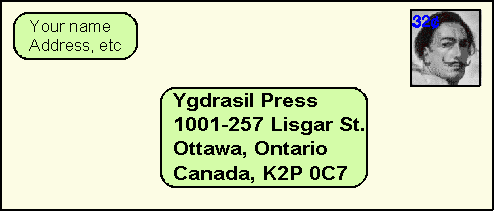
    Or mailed with a self addressed stamped envelope, to: